A stream
The subject stream that opens this path after class 10, so the next school choice is grounded in something real.
Sample career report
This is a career assessment report example, page by page, so you know exactly what a family and a counsellor receive. The report is called the Constellation because it maps a student as a set of related signals rather than a single score. For each part below you will see what it is, and what to notice when you read it.
Every number here comes from a deterministic engine. It is computed from the student's answers, never guessed.
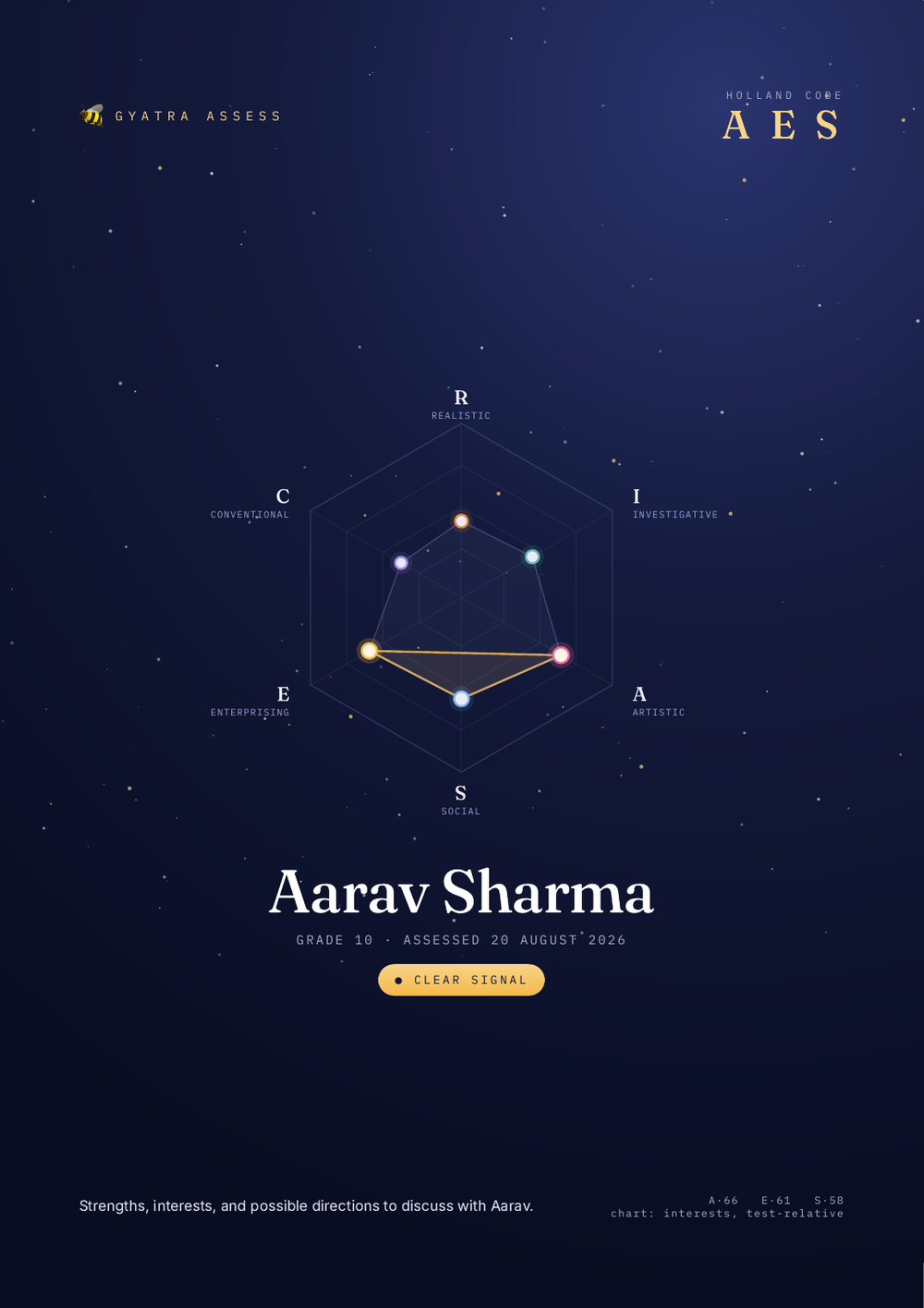
A. The cover
What it is: the first page shows the student's interests as a star-map, with the three strongest interests forming a three-letter Holland code, for example ASE or IRC. A confidence badge sits alongside it.
What to notice: read the three letters together, not the top one alone. The combination is what makes a student distinctive. Then check the confidence badge before anything else, it tells you how firmly to hold the whole report.
B. Interest profile
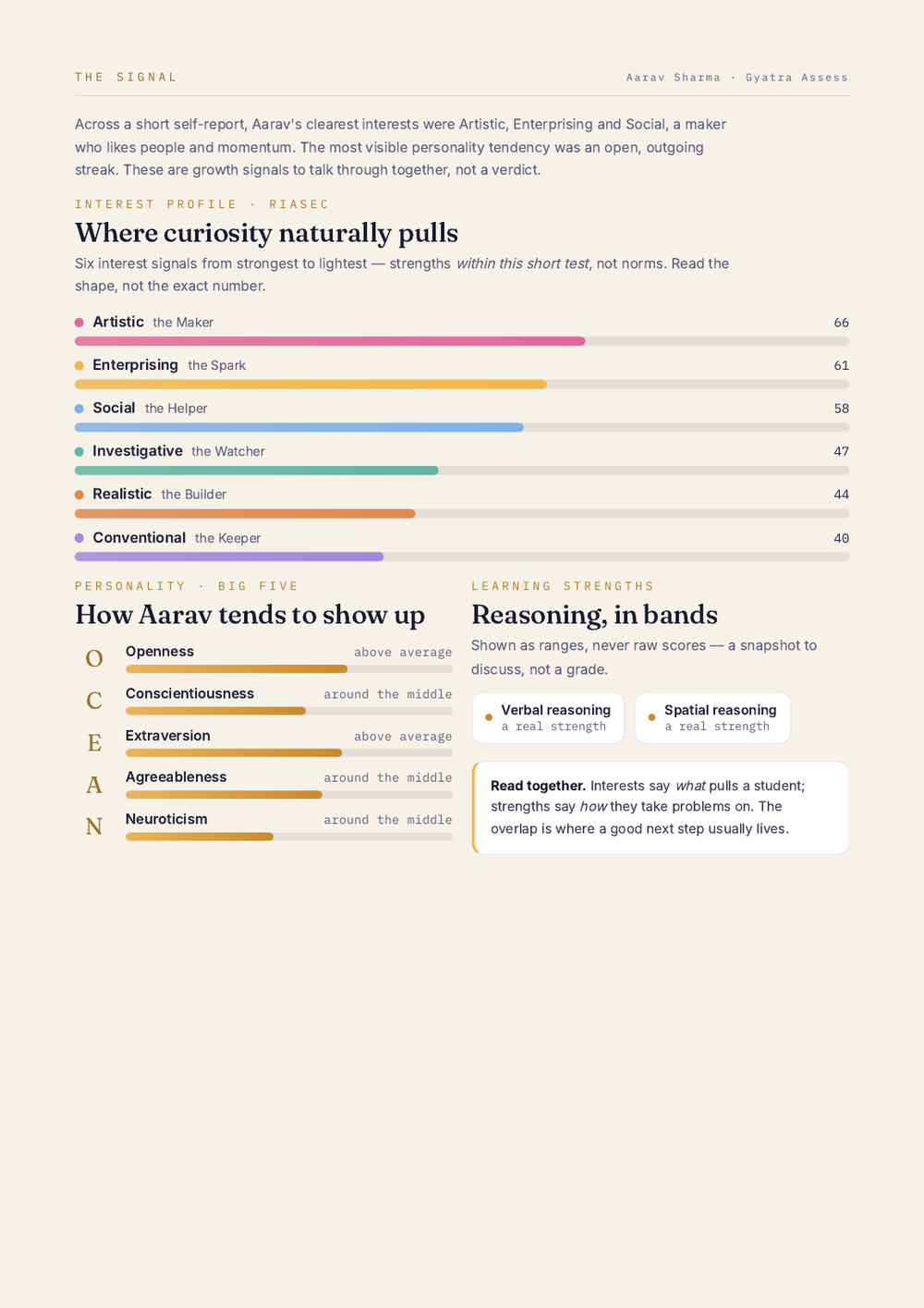
What it is: the six interest themes, shown as bars and ordered from the student's strongest to weakest. Realistic, Investigative, Artistic, Social, Enterprising and Conventional, each with a plain-language description of what that interest looks like in real life.
What to notice: the shape matters more than any single bar. A student with two or three tall bars close together has broad interests worth exploring, while one clear peak points to a strong pull. Low bars are not weaknesses, they simply are not where the spark is right now.
Hands-on, building, the outdoors, how things work.
Questions, analysis, science, figuring things out.
Design, expression, ideas, making something new.
Helping, teaching, caring, working with people.
Leading, persuading, starting things, taking charge.
Order, structure, detail, organising information.
C. Personality
What it is: five personality traits, openness, conscientiousness, extraversion, agreeableness and emotional intensity, each shown as a plain band rather than a number, with a short, kind description.
What to notice: no trait is good or bad, and every band has strengths. A quieter, reflective student and an outgoing, spontaneous one can both flourish. Personality tells you how a student's interests are likely to feel day to day, which is why it sits right after the interest profile.
D. Learning strengths
What it is: how the student reasons across verbal, numerical, spatial and pattern tasks, described as strength bands. Parents never see a raw aptitude number or anything resembling an IQ, because this is not that kind of test.
What to notice: read these as a natural head start, not a ceiling. A strong band shows where learning comes easily today. A softer band is simply an area that may take more practice, never a verdict on ability. Every band is relative to the student's own test, not a rank against classmates.
Counsellors can see the finer detail behind these bands. Families get the plain, encouraging version.
E. Directions to explore
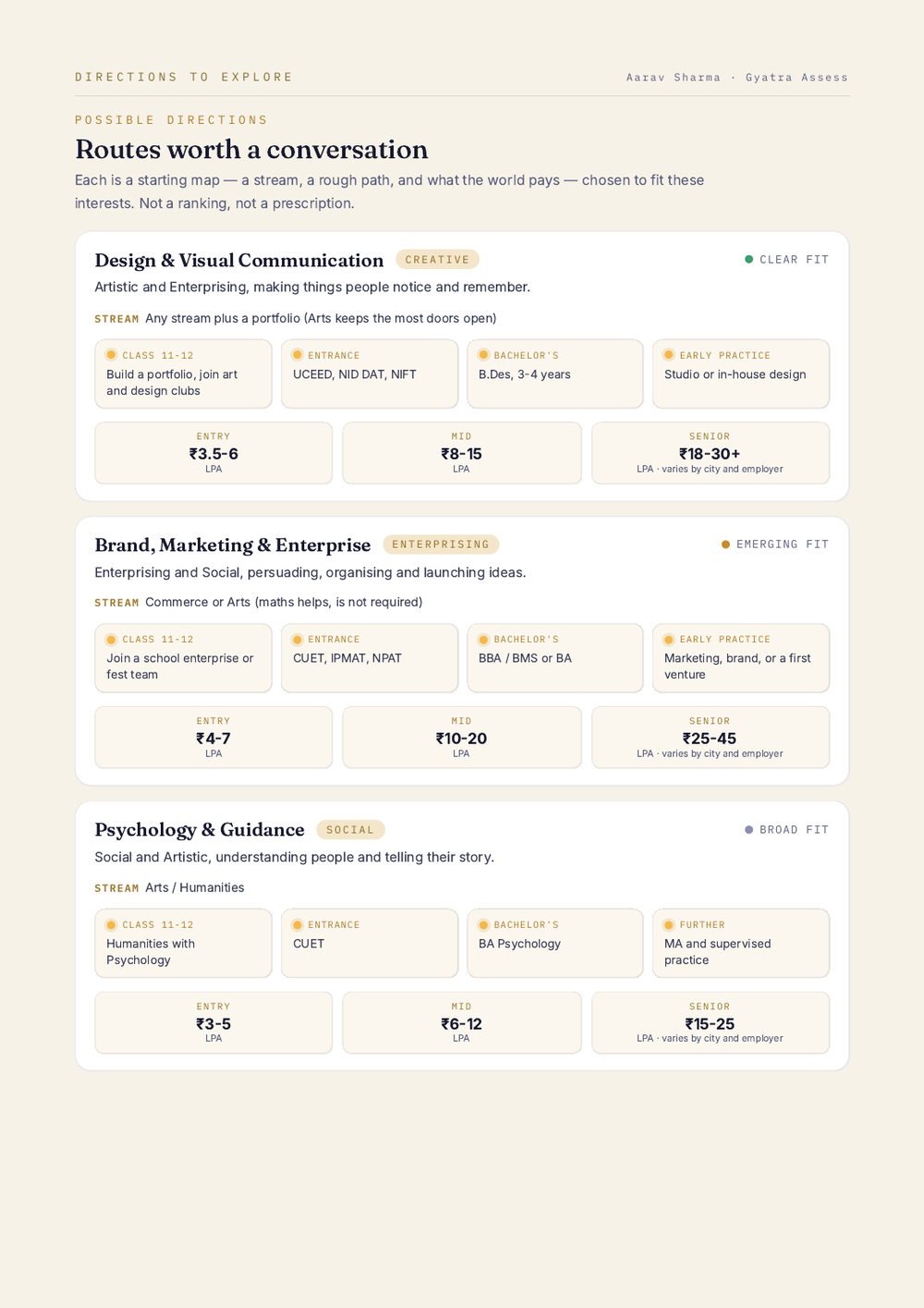
What it is: matched from the whole profile, each direction comes with a recommended stream, a rough roadmap of exams and steps, and an indicative pay range.
What to notice: these are directions to explore, not instructions. The roadmap shows a realistic path, the stream after class 10 through to entry, and the pay is an indicative range only, meant to inform a conversation, not to set an expectation. Salaries vary widely by city, sector and time.
Inside one direction
So a family can compare them fairly and see the real shape of each path.
The subject stream that opens this path after class 10, so the next school choice is grounded in something real.
The broad steps from here to entry, including the kind of entrance exams involved, drawn from a curated catalogue built for the Indian context.
A range, clearly marked as indicative. It sets rough expectations without pretending anyone can predict a single number.
F. How you can help
What it is: a short, practical section written for the family, small and concrete things a parent can do to support each direction the student is curious about.
What to notice: pick one or two, not all of them. The point is momentum, not a checklist. A subject to try, a person to talk to, an activity to explore this month.
A note on wellbeing
Where a school has opted into the wellbeing screening and a student's answers suggest they may need support, the report gently flags it for the counsellor rather than the family, so a caring adult can follow up in person. It is a prompt to check in, never a diagnosis. Gyatra is not a clinical or diagnostic test.
G. The honest disclaimer
The last page says plainly what the report is, and what it is not. We put it in every Constellation because it is the truest thing we can tell a family.
"We would rather say, honestly, that a child's interests are still forming than hand a family a confident label that isn't true."
Keep reading
Bring the Constellation report to your school, or read it as a parent first.